Showing posts with label Herons. Show all posts

Wednesday, March 25, 2015

Where have all the heron gone?

by Nick Kotula, JRA Guest Contributor

Every year the swallows return to Capistrano.  Every winter the monarch butterfly returns to Mexico.  When a new iPhone comes out all of our old iPhones don’t work as well as they used to.  And at the beginning of spring the herons return to their nesting spot by Pipeline Rapids in Richmond, Virginia on the James River.  This is just how the world works.  Or so I thought.

You may or may not remember my reporting on the heronry (herons + rookery = heronry) in 2012 and again in 2013.  I’m not the only one who expected the return of these fantastic birds.  The City of Richmond has flags proclaiming the “Heron Rookery” and the James River Park System has signage explaining their mating and nesting habits at Pipeline Rapids.  Perhaps we were all naïve, because this year the herons did not return.

An active heronry in early February 2012.

Nothing but empty nests in late March of 2015.
I first went to check on the heronry in early February.  It was cold, and it had been even colder so I wrote off the lack of feathered friends as a wintry fluke.  Wouldn’t you have liked to stay south this winter?  Come the beginning of March, I began to have my doubts.  This week I went to check up one more time, and only found one solitary heron.

One is the loneliest number that you'll ever do.
When not in mating mode, the heron is a solitary and territorial creature.  After an hour spent on the rocks and the pipe at the rapids, I had to conclude that this was this singular heron’s territory, and there would be no nesting here this year.  The Richmond-Times Dispatch had written a piece earlier in the month about this, but I wanted proof and I refused to give up hope.  But a heronry is not a fast endeavor.  Courting is a complex process, even for herons.  Much like humans the heron males has to display his manly feathers, dance the man dance of his people, and lock bills with his intended.  The males then spend weeks collecting the stickiest sticks that they can find, building the perfect nest they can and then watching as their intended completely shows them how everything they did was wrong and does it themselves.  And don’t even get me started on the mating!

The point is this all takes time.  If it hasn’t happened yet, it’s not likely to happen.  Much like the Purple Martins (whose murmurations inspired a festival at the 17th Street Market in Richmond), the herons have found somewhere else to nest in 2015, and we may never really know why.

He's certainly not telling.
So what does this mean?  Well, on a positive note:  A heron with little heron mouths to feed typically consume about 4 times their body weight in fish per day.  Despite their large size, your typical heron only weighs about 5-6 lbs due to their hollow bones.  So that’s about 20 lbs of fish per day.  Adult shad weight between 3 to 8 lbs, for our purposes we’ll average this out at 6lbs.  That means every heron that is not here means an extra 3 (and some change) shad per day.  (The shad run through Pipeline was thought to be one of the primary reasons for the heronry, but they are known to eat other fish and also amphibians and even rodents!)  Multiply that 3 fish by the 100 or so herons that were usually there and you end up with a lot less competition for a lot more fish for those humans who enjoy that kind of thing.  (This all assumes that the herons are not nesting further downstream and catching them before they ever make their way to Pipeline.)  If the run is good again this year, fishermen should take delight.

And a good year for osprey!
Personally though, it just makes me sad.  The return of the herons was like seeing good friends who abandoned you for warmer climes during an absolutely miserable winter.  They were a sign of spring more potent to me than daffodils or tax forms.  While I’m glad to see one hunter holding down the fort (so to speak) I really hope next year sees a return of my winged brethren, otherwise those flags are going to look pretty daft.


Monday, June 25, 2012

My Heron Song (As Opposed to Swan Song)


By Nick Kotula, JRA Guest Contributor
 
Clearing throat.  Playing pitch pipe.  Ahem… QUUARRRK!  SQUAAAAWK!  KWAAAaaaaark!...  Thank you, I’ll be here all week.
Heron onomatopoeia (I’d like to buy a vowel, Pat) aside, with the arrival of the Summer Solstice I am wrapping up my official visits to the Richmond Heronry at Pipeline Rapids.  I went out for one last visit.
A few of the adults are still popping by for visits, but for the most part the island is ruled by the kids.  You can distinguish the kids from the adults because they have spiky hair and listen to the most ridiculous music.  Seriously though, the crests of the juveniles are markedly different and they have not developed their full colors yet.
In addition to the GBHs there was another good friend there to say goodbye.  This osprey was perched in a nearby tree just waiting for his close-up.  Actually, there was an adult GBH fishing in the water nearby.  The osprey was watching and waiting.  The GBH caught a fish, and the osprey swooped in to steal it away.  Needless to say, the GBH was not happy.
If you head down to Pipeline you are probably going to see that there is a family of whistle pigs that haven taken up residence near the entrance.  Some people call them groundhogs, but the thought of a pig whistling makes me chuckle each time I say it.
Lastly, to celebrate the solstice the James River Park System held a candle float.  At least 30 people, including Ralph White, showed up to light things on fire, send them down the canal, and make a wish.  I assume the majority of those wishes were for cooler weather (which seems a bit counter-intuitive to me).
Getting serious for a moment, I have really enjoyed learning more about the Great Blue Heron, the James River, Pipeline Rapids, and the other creatures that call it home.  I’d like to thank the James River Association for both working to protect this precious natural resource and for giving me the space to talk about it.  I would also like to thank you, the reader, for well… reading!  I hope you have had as much fun as I have.  If there is anything else you would like to know about (be it bird, river, or otherwise) leave me a message in the comments!  I’ll still be around and I’m always happy to talk.

Thursday, June 14, 2012

Honey, I Shrunk the Heron!


By Nick Kotula, JRA Guest Contributor 

Have you been down to the heronry and just thought, oh those are cute but I just don’t think they have them in my size!  Well, have I got news for you!  Meet the latest addition to the Herons Nick Has Spotted at the James (rhymes with stems) River Collection:  the GREEN Heron!
If a GBH is a tall drink of water, then the Green Heron is a Dixie cup.  Measuring only about 17 inches in height, these little guys are not seen as often as their larger, bluer cousins.  This is largely because they are mostly nocturnal, and when they are feeding during the day they have a tendency to stand perfectly still while hunting.

A couple interesting facts… the GH (continuing the trend) is considered one of only birds that fishes with bait.  They will often find catch insect or other small objects and drop them into the water.  Fish sees a delicious treat, goes to eat it, and next thing you know, lunch!  They are also able to hover briefly to catch food.  They are also seasonally monogamous, meaning they find a mate and stick with them until next year.
I found this little guy hanging out around Reedy Creek (up river and across the water from the heronry) basking in all the hard work of the hundreds of volunteers who were working to clean up his living room!

Wednesday, June 6, 2012

Old Whitewater, Keep on Rollin’


By Nick Kotula, JRA Guest Contributor

In the west corner, formed almost 440 million years ago during the Taconic orogeny, the apple of the Appalachians, the stinger of the Shenandoah… The Piedmont!

In the east corner, with an average height of just 300 feet above sea level, the boundary of the ocean, the slugger of the seaboard… The Atlantic Coastal Plain!
 
That’s right, ladies and gentlemen, these two heavyweights meet up downtown on a regular basis in one of Richmond’s oldest venues, the Atlantic Seaboard Fall Line!  And what do we get when two areas with different sediments meet across a river?  (An escarpment!)  That’s right, rapids!  And what do we do with rapids?  We inflate pieces of rubber and hurtle ourselves down them!
That’s exactly what I did this past Memorial Day weekend with Riverside Outfitters.  We started the journey at the 35 Cent Bridge (calling it the Nickel Bridge is just lying to yourself) and wound up at the 14th Street take out by the Mayo Bridge.  In between plummeting down Class II-IV rapids (the only ones that run through a major U.S. city, thank you very much) we were treated to a whole new way of seeing the river.  I was fascinated watching an osprey being chased by a bald eagle for the fish that he had, when suddenly we were plummeting down to Pipeline Rapids and the heronry!
 
 Afterwards, I headed over to check out how the GBHs react to the antics of the strange bipedal fleshy creatures that like to float on top of the water instead of standing in the middle of it like normal.  They seem generally unfazed.
In a couple of side notes:  The Albizia julibrissin (mimosa) trees are in full bloom by the Pipeline.  I find these fragrant flowers to be beautiful, but it should be noted that they are not originally native to Virginia.  Also, I saw some Gerridae (water striders) out enjoying the river.
Riverside Outfitters offers white water rafting and inflatable “ducky” kayak tours when the water level permits.  You can find them at their Southside location (6836 Old Westham Rd. Richmond, VA 23225) or wait for their new location that will be opening on Brown’s Island starting June 15! You can read all about it here!

Friday, May 25, 2012

On Vauxhall Island

By Nick Kotula, JRA Guest Contributor

The GBHs are not the first gray coated visitors to Vauxhall Island as this newspaper article explains:

Vauxhall's Island. “The Richmond Light Guard, Capt. Wallace, have selected the above delightful spot, located on James river, as a camp ground, till their equipment, &c., is fully completed and they start on active duty in the field. The company lacks a few men of the required number-100.”  - The Daily Dispatch, Richmond Dispatch: July 22, 1861. (This would eventually become the Richmond Times-Dispatch!)

The Richmond Light Guard (later to be dubbed The Richmond Infantry Blues) eventually departed the delightful spot and were sent to fight along the Potomac River.  In February of 1862 they were ordered to Nag’s Head and then to Roanoke Island where they were taken by General Ambrose E. Burnside during a “short but severe” battle.

The current siege at Vauxhall also finds the spot to be quite convivial, and they will probably not be shipping out to the OBX anytime soon.  River levels were high this week, though not nearly as high as in 1847 when Vauxhall was completely covered.  (Newspapers from 1800s Richmond are insanely interesting!) The increase in water levels also caused a surge of what appear to be shad.  While the herons couldn’t handle their normal wading grounds, they could easily stand on the banks and grab lunch by pretty much putting their beaks in the water at random.  I’m going to be replacing “shooting fish in a barrel” with “stabbing fish with your beak in the James (pronounced “Gems” as we decided in my last entry!) when the water levels are at approximately 11 feet above normal.”  It has a ring to it.

Another visitor to the Vauxhall area popped up again this week.  Remember, snakes are cold blooded, so you can usually find them sunning themselves on the warm rocks in the sun like these Northern Watersnakes.  Speaking of things on the rocks… until next time!

Friday, May 18, 2012

To Be Read With a British Accent…

By Nick Kotula, JRA Guest Contributor

A scene taken rather later in the year shows the interior of The Richmond Heronry with a glade in the centre and gleaming silver birch stems, and on either side twin oaks, one dead and deserted, the other living and adorned with three herons’ nests.  Above it soars one of the birds.  By the first week in April the young are often hatched, but as a rule, it is not till the middle of the month that their chattering cry for food is heard. – Country Life Illustrated, Volume 5

One could easily think that this quote from a book from 1899 was referring to our heronry, but in fact it is referring to a heronry that is in Richmond, England (a town near London) on the Thames!  (Rhymes with “stems.”   I propose we start pronouncing James the same way.)   Further proof that the founders of our fair city were both homesick and rather unoriginal in their naming practices.  The Vauxhall in Vauxhall Island is also a suburb of London.

One thing that the British heronry doesn’t have is the Northern Water Snake (seen here investigating me from the bubbles of a raging river).  I will allow you to decide whether this is a good thing or not, but keep in mind that they are non-venomous.  (It’s always good to know that a snake is not going to kill you when it pops up two feet from your foot.)

Meanwhile, the GBHs seem to be getting a little sick of living so close to each other.  This picture is just one of the turf wars that I witnessed.  Pretty soon they are going to be slicking back their plumes and starting a rumble a la “West Side Story.”
I shall leave you with one last image that is practically guaranteed to make you say, “Awwwww!”  These Canada geese goslings were hanging out with about 20 of their brothers and sisters.  Their hissing parents were the only thing that stopped me from climbing down there and just hugging them!  They’re so fluffy!
 

Thursday, May 10, 2012

The Great Blue Heron Rises

By Nick Kotula, JRA Guest Contributor

Perched high above the bustling metropolis I sit and wait.  Armed with fancy electronic gear (where does he get these wonderful toys?) I watch.  I am the hero that Richmond deserves…
 Ok, maybe I’m not Batman; but it is fun to pretend.  (The mask and cape might have been a little much, though.)  I promised you some better pictures of the GBH nests, and I hope you will agree that I have delivered!
At about four weeks, mom and dad will start to leave the chicks alone in the nests while they go hunting.  We seem to be at that point right about now.  So counting back four weeks, it would appear that these chicks were born right around the beginning of April.  I would like to take this opportunity to point out that I rock!
So what do we have to look forward to?  In about three weeks the chicks should first start leaving the nests to hop around in the surrounding trees.  Give them another week and they should start taking to the air.  At twelve weeks old the parents are going to start leaving the heronry to return to their regularly scheduled solitary lives.  The babies will head out soon after to return next year and start this whole circle of life thing all over again.  (I have images of a monkey holding up a baby GBH while Elton John is singing now.)
If my predictions hold true, we have about another eight weeks of heronry updates ahead of us.  Also, flying cars…  (Hey, I can hope.)

Friday, April 27, 2012

Happy Birthday!


By Nick Kotula, JRA Guest Contributor

I have been thinking about how to see if there are GBH (Great Blue Heron, I’m starting a thing here) chicks at the heronry for quite some time.  Do I get a bunch of balloons and strap them to a lawn chair and float from the Mayo Bridge?  Do I go out and buy a $300 remote controlled plane and ask for permission to buzz the tower?  Do I contact some people that I know and have NASA position a satellite in geosynchronous orbit above the heronry?  Fortunately (for my well being, my wallet, and not getting questioned by the CIA), my wife vetoed all of these ideas.  Instead, I decided to just pay three dollars and go to the top of the Troutman Sanders parking garage with my telescope, a camera, and a dream.
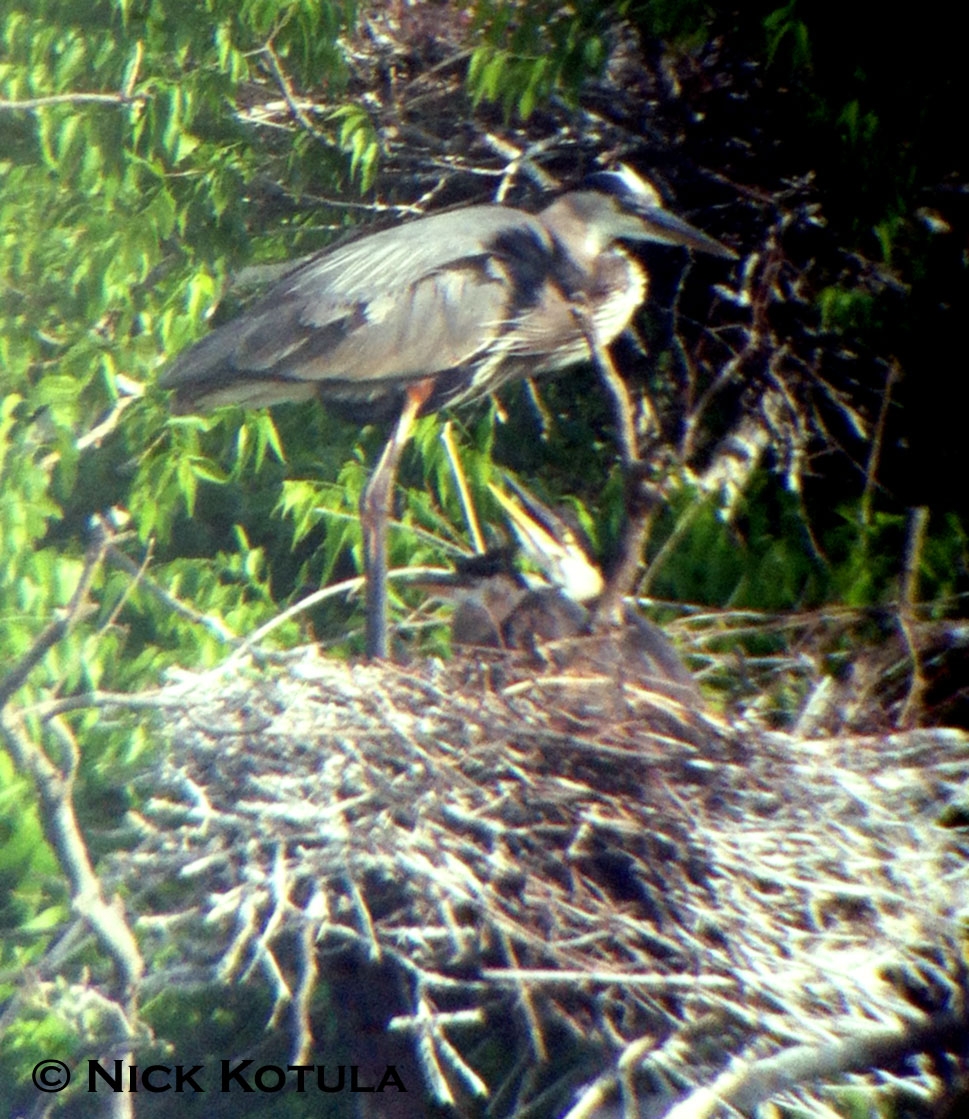
I’m not going to lie to you, taking pictures through a device designed to let me see the rings of Saturn and the Great Red Spot of Jupiter (it is actually fairly great) seemed a lot like bringing a bazooka to a knife fight.  I also felt a little weird on a bright sunny day at the top of a parking garage (no one parks on the top) with a telescope, and the resulting pictures were not fantastic.  However, I was able to snap this shot.  It wasn’t until I got home that I realized that if you look just to the right and down from the stooping back of the GBH you see… a small GBH!  Houston, we have a chick!  (Keeping with the astronomical theme.)  I’d light up a cigar, but I don’t know if it should be an Itsaboy or an Itsagirl…
 Meanwhile, at ground level, the GBHs continue to prowl the waters looking for food.  We’ve already seen a GBH swallowing a whole fish, but GBHs have also been known to eat snakes, frogs, mice, and even rabbits.  Pretty much whatever they can get their bills on.
If you head down to the heronry, make sure you take a look at some of the more human activities going on as well.  Right next to the parking lot is an art walk with a bunch of murals (officially sanctioned murals, unlike some of the other works of art you might see) commissioned as part of the RVA Street Art Festival.  Here’s a picture of one of my favorites.  (For obvious reasons.)
 

Friday, April 20, 2012

Gone Fishing

By Nick Kotula, JRA Guest Contributor

There’s more than one way to catch a fish.  You could make like a human and buy a reel and some worms and sit for a few hours.  You could pretend to be an eagle or osprey and fly above the river looking for the first sign of a fish and dive head first after it.  Or you could be a Great Blue Heron (which lacks the keen eyesight of the raptors, and does not have opposable thumbs or an understanding of economics) and stand in the middle of the river waiting until something swims by.  Egrets do the same thing, despite what watching this guy soar around made me think.

Herons are especially well adapted to these aquatic adventures.  Like the beginning of a film noir movie, herons have legs that just won’t quit.  Much as a giraffe’s neck gives them access to leaves that other animals can’t reach, a heron’s legs (now I have a ZZ Top song stuck in my head) allow them to wade into deeper areas than most birds can get to.  This heron was so busy hunting that it let me get extremely close.  Notice that she (I have no way of actually knowing, but she felt like a she) is making full use of those legs to keep the majority of her body out of the water. 

If half of a heron is leg, a significant portion of the remaining half is neck.  Herons use their long necks to deliver a quick dive into the water that will either spear an animal with their long, sharp bills or simply catch them to swallow whole.  If you look along the neck and the back of the heron you will notice that some of their feathers are longer and thinner.  These are powder down feathers and are designed to break apart during preening.   (Of course there is a fancy term for when birds clean themselves, did you expect anything else?)  This powder helps wipe of any slime or dirt that can occur when you routinely dunk your head into a river looking to catch a fish in your mouth.

Last but not least are their feet.  Unlike a lot of birds that spend so much time in the water, they only have partially webbed feet.  The webbing found between their front two toes help prevent them from sinking into the mud while wading, while the non-webbed feet allow them to grasp rocks and branches.

On my last visit there were at least ten herons in the water actively hunting at any given time.  It is truly an interesting sight to watch these niche feeders patiently waiting/wading through the James.