Showing posts with label River Hero Home. Show all posts

Thursday, September 17, 2015

There’s Hardly any Lawn at this River Hero Home!

Mark and Sally Wittkofski live in Henrico, Virginia with their son Nick. All three are garden enthusiasts and love Richmond’s James River Park System. Mark is semi-retired and describes himself as self-employed in Residential Garden Maintenance. Sally is a Landscape Architect/Landscape Designer. Their son Nick is currently a Fellow at the Allegheny Mountain Institute learning about organic gardening and permaculture.

The Wittkofski household is a certified River Hero Home. They decided to become a River Hero Home because they have been practicing organic gardening for a number of years, but wanted to be connected with others in the community who can provide information and resources to help them become better stewards of the James River.


Nick is interested in sustainability and permaculture. He encouraged his parents to install more river-friendly practices and eliminate most of their lawn by planting native plants in its place. There are two rain barrels at their house that collect about 70% of the rainwater from their roof. The other drain flows into a series of ditches, berms and rain water collection ponds to keep the water in the yard, rather than flowing into the sewer. Since most of their lawn is gone, the rain water is soaked up by native trees and shrubs.

The Wittkofskis want to encourage their friends and neighbors to eliminate the use of chemical herbicides and pesticides in their yards. These chemicals are dangerous to wildlife and have negative effects on the health of the James River. Instead, they encourage everyone to become a River Hero Home. Positive individual actions can result in a safer, cleaner environment for everyone. By installing river-friendly practices to prevent chemicals, bacteria from pet waste and sediment from entering local waterways, we can keep our river safe for recreation and clean for drinking water.


Thursday, September 10, 2015

Education and Conservation are Key for this Lynchburg River Hero Home


David Stokes showing off vegetables from his
garden in front of a wall of climbing spinach
David Stokes lives in Lynchburg, Virginia a few miles from the James River with his wife Gail. He has certified his home as a River Hero Home and believes in helping educate the public on the importance of native plants and water conservation.

Even though David is retired, he is a very busy man! He is a certified Master Gardener and he volunteers much of his time educating the community about the importance of plants. Through the Master Gardener program, he works with DePaul Family Services to maintain a flower and vegetable garden to teach the importance of growing your own food and eating healthy. David also spends time at the Lynchburg Juvenile Detention Center where he works with teenagers planting a vegetable garden to grow produce for their meals. He is also president of the Vietnam Veterans of America Chapter 196, a member of the American Legion and on the Commanders Board at the Salem Veterans Administration.

Becoming a River Hero Home was a no brainer for David. He has seen changes, both good and bad, to the river over his lifetime and has spent many years enjoying the James. Since he has been recycling for over 45 years and his home is on well water, it seemed only natural to recycle his rain water too. The Stokes’ have rain barrels, rain cubes and a drip irrigation system installed at their home. He uses the water he collects to water his native plants and trees.

Rain cubes collect runoff from your roof when it rains.
And he sure does he have his system figured out! With a beautifully landscaped lawn full of native plants, as well as a vegetable garden, David needs quite a bit of water. With his current setup, a half an inch of rainfall allows him to collect over 900 gallons of free water!


David says it is important to practice what you preach. If you believe in conservation, then setting up a rain collection system is a great way to do your part to conserve water.  Using this water to help your native plants thrive also provides habitat for wildlife and improves water quality in the James River. 

Tuesday, September 1, 2015

September is for River Lovers

River Hero Homes receive a colorful garden flag 
September marks the beginnings of crisp mornings, kids going back to school and the fall planting season. At the James River Association it also means River Hero Home month. All month long, we will be sharing river-friendly tips, highlighting our partners and introducing you to River Hero Homes in our watershed.


Let’s start with the basics. What is a River Hero Home?  If you work to reduce runoff from your yard through a river-friendly practice like installing a rain barrel or planting native plants, you’re eligible to sign up for our River Hero Homes program. All you need to do is commit to a few simple, every day actions like picking up after your pet or smart lawn maintenance. Once you do that, fill out a form and send us a picture of your river-friendly practice and we’ll take care of the rest. River Hero Homes certification includes a membership card that gives you discounts at local home and garden shops, a colorful lawn flag and an invitation to our annual River Hero Home Lawn Party.

Rain barrels capture stormwater from your roof, 
which you can use to water your plants
Want to know more? Follow us on Facebook to learn about ways you can protect the James at home. Check our blog to see posts about homeowners like you who are turning their lawns into river-friendly havens for wildlife. Join us at the annual James River Regional Cleanup to show your dedication to a healthy James River - there are 14 locations throughout the watershed, so where ever you live, you can get involved.

And of course, we invite you to certify your home as a River Hero Home. 

Native plants filter stormwater runoff and provide habitat for wildlife

Wednesday, August 27, 2014

Free Trees for Richmond City Residents

Do you live in the City of Richmond?  Are you interested in planting trees in your yard and becoming a River Hero Home?  If you answered yes to both of these questions JRA wants to give you free trees! 

During the fall planting season, JRA is offering free trees to Richmond City residents. You can receive up to a $200 reimbursement per home for trees planted on your property.

Trees are an important feature for any property because they reduce stormwater runoff and provide aesthetic value. Tree canopies capture and store rainfall and reduce soil erosion. They take up a large amount of water from the soil and provide important habitat for wildlife. Their shade can also help homeowners reduce the cost of cooling their home.

This tree incentive program is only open to City of Richmond residents and reimbursements are available September through November 2014. You must be an existing River Hero Home or submit an application to become a new River Hero Home to qualify.

River Hero Homes is JRA’s certification program that recognizes homeowners who are successfully taking steps to improve water quality by reducing the amount of stormwater and pollution leaving their property. To become certified, JRA requires homeowners to install a river-friendly practice, such as planting trees or installing a rain barrel, as well as following some simple everyday actions to reduce pollution. These actions, which include picking up after your pet or planting native plants, may seem small, but when adopted on a wide scale, can have a significant impact on local water quality.

Tree reimbursements are available on a first-come, first-serve basis and will be available until funding runs out. For more information about this program, and to find out if your property qualifies, go to www.jamesriverhero.org.  

Wednesday, May 21, 2014

JRA Brings River-Friendly Landscaping to Habitat for Humanity Project

Over the past several months, JRA has worked with the Richmond Metropolitan Habitat for Humanity (RMHFH) to provide river-friendly landscaping to The Pillars at Oakmont in Richmond’s Church Hill neighborhood. This mixed-income community was completed last spring by RMHFH along North 33rd Street between T and Kuhn Streets.

In February, JRA’s Watershed Restoration Team met with nine homeowners from the community to teach them how using native plants in landscaping creates a river-friendly yard that helps protect water quality. We worked with the homeowners to design landscapes for their yard that would not only meet the needs of their families, but also help the James River. 
GE volunteers gather before getting to work!
On Friday, May 9, an unusually hot Spring day, JRA was joined by representatives for RMHFH and 50 volunteers from GE for a work day at the Pillars to put the landscape plans into place Several local companies, including Yardworks, Luck Stone, Pete Rose Landscape Products, Glen Allen Nursery and New Line Hardscapes, provided assistance and/or in-kind donations for this project. Several members from the Central Virginia Landscape and Nursery Association (CVLNA) volunteered and taught volunteers the proper way to install plants. Members of the Old Dominion Chapter of the Interlocking Concrete Pavement Institute (ICPI) came to lead volunteers in the installation of the patios.  

Mulching around our native Blueberry shrub!

Big thanks go to members Brad Swortzel from BWS Landscaping and Mike Hart from Homescapes Ltd for leading the patio install.

Teams of homeowners and GE volunteers worked together on the backyards to complete various landscaping tasks, such as installing paver patios, prepping garden beds and planting native trees and shrubs. Native plants are an important aspect of river-friendly landscaping because they are adapted to local soil, rainfall and temperature conditions. These traits allow them to grow with minimal use of water and fertilizer and help reduce stormwater runoff from your property.
Proud homeowners enjoying their new native landscape!
All nine homes at the Pillars at Oakmont will become certified River Hero Homes, which is a way to recognize these homeowners for successfully taking steps to improve water quality by reducing the amount of stormwater and pollution leaving their property. Anyone living in the James River watershed can become a certified River Hero Home. It is a simple way you can help protect the James River.
One of nine new native gardens at The Pillars

Tuesday, April 1, 2014

April is for River Lovers!

JRA has designated April as River Hero Home month! 

All month long we will be offering  tips and ways you can make your home more river-friendly.

What exactly is River Hero Homes?

Every time it rains, fertilizers and herbicides, bacteria from pet waste, chemicals and sediment flows from your property into local waterways. River Hero Homes is JRA’s way of recognizing households that take the extra steps to improve water quality by reducing the amount of stormwater (and pollution) leaving their property. 

JRA currently has 187 households who have included river-friendly practices and everyday actions to their lifestyles, which have significant impacts on water quality.

If you are interested in becoming a River Hero Home, fill out the on-line application and send us a picture of your river-friendly practice.  Once we approve your application, we will contact you and send your certification materials.

In the meantime, ‘like’ us on Facebook and ‘follow’ us on Twitter to receive tips, tricks and info on how you can make a difference!

Thursday, October 17, 2013

Do you live in the Lynchburg area? If you do, JRA wants to give you a Free Rain Barrel!

Rain barrels waiting for their new homes!
Thanks to funding from the National Fish and Wildlife Foundation and a partnership with Lynchburg Grows, JRA is offering the first 100 certified River Hero Homes in the Lynchburg area one free rain barrel per household! 

Why become a River Hero Home?
Even if you can’t see the James River – or any body of water – from your house, your actions still impact the health of the James River and its tributaries.  Every time it rains, fertilizers and herbicides, bacteria from pet waste, chemicals and sediment flows from your property into local waterways.  This pollution results in everything from cloudy water to algae blooms and can make our waterways unsafe for swimming and fishing.

What do you need to do?
You can become a River Hero Home by completing 3 simple steps, many of which you may be doing already.  These steps, which include installing a river friendly practice such as rain barrels and everyday actions such as picking up after your pet and reducing fertilizer use, may seem trivial, but they can all have significant impacts on water quality. Simply fill out the on-line application and send us a picture of your river friendly practice. 

If you don’t already have a River Friendly Practice installed, you can use your free barrel to qualify!  Simply submit your application now and send us a photo after your barrel is installed. Once we receive your application, we will contact you and send you your certification materials. And if you are one of the first 100 homes in the Lynchburg area to qualify, we will send you a certificate for you to pick up your free rain barrel at Lynchburg Grows!

Regardless of whether you already qualify or if you will be using your free barrel as your river friendly practice, please make sure to enter the word “Lynchburg” in the box on the application that asks if you are attending a rain barrel event.

Rewards

In addition to one free rain barrel for Lynchburg residents, every certified home receives an attractive garden flag and window cling with the River Hero Home logo, access to a dedicated Google group and newsletter, and an invitation to the annual River Hero Home Lawn Party.  Members also receive exclusive discounts at participating local garden shops and nurseries. Finally, depending on where you live, becoming a certified River Hero Home may also help you qualify for stormwater rebates or credits offered by your locality.

Tuesday, October 15, 2013

Part III—From Flooded to Fantastic!

By Linda Mills, JRA River Hero Home

If you’ve been following the saga (see August 26 and September 16) of how our runoff-laden yard was transformed last summer from homely to healthy, here is the final installment. Because of grant money distributed and monitored by the Alliance for the Chesapeake Bay, we welcomed three fabulous projects into our landscape. The wonderful guys from Greener Landscapes (paul@greenerlandscapes.com, 804-432-3623) worked with us to produce a rain garden, a BayScape and a patio of permeable pavers.

Backyard flood plain.
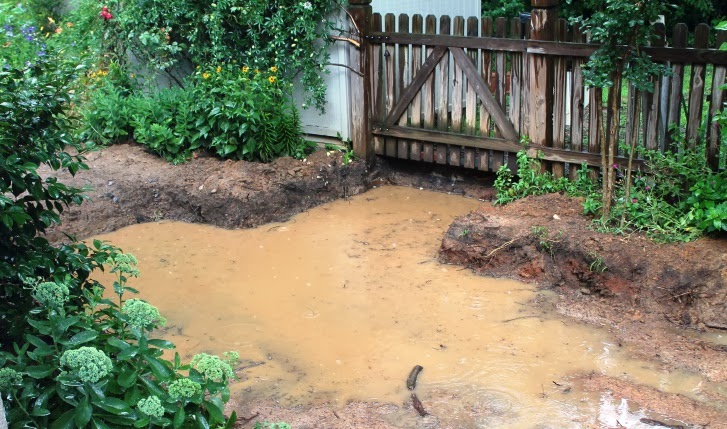
The area in the photo below was the “flood plain” behind our house. The gate (left side of photo) exits to the alley. When it would rain hard, water would pour off the several pitches of our roof, overflow the rain barrels (yes, two rain barrels), and wash through this area as it rushed toward the alley. Once in the alley (that actually has ruts from the flowing water), the runoff flowed into the street, consequently making its way to Reedy Creek a block away.       


To fix this substantial runoff issue, the contractors dug down about 14 to16 inches with a backhoe. (They also dug out the rain garden while the backhoe was there.) The ground was hard clay. You can see from the photo below, that after several heavy rains, the water did not drain. At all! (Remember how it just kept raining early in the summer?) We christened this area “The Pit.” Because this was the last project to be completed, this lovely muddy mess sat for several weeks. We thought about stocking it with fish. A friend recommended buying a canoe so we could take out the trash.

The Pit
But eventually, the rains stopped and it was time to focus on The Pit. The first step was to dump a load of large-gauge rocks in the bottom. The second load of rocks was a bit smaller gauge. The third load was an even smaller gauge, like medium gravel. It exhausted me just to watch the Greener Landscape guys move those rocks. Talk about aerobic exercise!

Once the gravel was in place, the really exciting stuff began. For the pavers, we chose tumbled bluestone. We wanted a natural feel instead of a more precise brick look. The stones the fellows chose were beautiful. We purchased about ½ ton of extra stone, not included in the grant money, so that we could extend the path slightly. (A half ton sounds like a lot, but it was only about six rocks!)

Paul, the rock expert on the team, artistically placed each piece of tumbled bluestone in the precise best spot, taking into account both the look of the pattern and the practically of the design. Paul leveraged and leveled the stones into the smaller gravel with enough space between them (about two inches) to allow water to drain into the gravel. He is an artist and an engineer!

According to Jacob Bauckman at Alliance for the Chesapeake Bay, designing the patio with larger spaces between the stones was the best solution for our particular problem. If we had used bricks or pavers with narrower gaps between them, we might have still had runoff, especially as the gaps “filled in” after a few years. There were no new plantings in the area, but we did weed, trim and mulch. We are overwhelmed with how beautifully it turned out. And when it pours? No water runs off the property. Win, win!

         
Fabulous and functional!
But what happened to all that extra dirt that was dug from the rain garden and The Pit?  There was a lot of dirt to deal with. But the Greener Landscapes fellows had done this before. They took the dirt from the two excavated areas and used it to construct the berms for the BayScape. It was the perfect solution—there was no dirt dumped into the landfill and it gave us this lovely flowing berm around the outside of our fence. The BayScape was planted with our choice of interesting and colorful native plants, including sweet bay magnolia and service berry. Other perennials included bee balm, rudbeckia, wild geranium, giant purple hyssop and Virginia sweetspire. We also are looking forward to fresh blueberries next summer from our own native bushes—if we can beat the native birds and squirrels to them.

BayScape berm (foreground and background)
as the plants were going in
Now that all three of our projects are complete—a rain garden, a BayScape and a patio of permeable pavers, we are thrilled with the results. Our runoff has decreased substantially, if not totally.  We’re glad to know that we are earning our River Hero Home status more than ever by not contributing runoff to Reedy Creek, and therefore the James River. As we tend our new rain garden and BayScape, and anticipate the gorgeous blooms of next spring and summer, we are also gratified that native plants and wildlife call our yard home.

Thursday, October 3, 2013

If you aren’t one of JRA’s River Hero Homes, here’s what you missed!

By Michelle Kokolis, JRA Watershed Restoration Project Manager


On Saturday, September 28, one hundred of our certified River Hero Home owners and their families gathered under the stars at Cross Creek Nursery in Chesterfield for the First Annual River Hero Home Lawn Party.  The party was JRA’s way of saying “thank you” to all the dedicated homeowners who have taken steps to keep runoff and pollution out of the James River and its tributaries.  It was also a way for us to thank all of the businesses that support our program and offer discounts to certified homes.

JRA receives a lot of support from local businesses and it is important for us to return this support whenever possible, so we focused on utilizing small, local vendors.  Guests were treated to a BBQ and fried chicken dinner from David Napier’s White House Catering, as well as local beer from Hardywood Park Craft Brewery and popsicles from the King of Pops.  In an effort to create as little waste as possible, we served water, tea lemonade and beer in reusable, commemorative cups and didn't offer anything bottled.


The River Whyless, a four-piece folk-rock band from Asheville, NC provided the music. And they were fabulous! The evening also included a plant swap during which participants brought plants from home and traded them in on plants brought by others. There was a raffle featuring prizes from some of the local vendors that support River Hero Homes.


We would like to thank everyone who came out to make our first River Hero Home party such a great success!  We would also like to offer a special thank you to Cross Creek Nursery for allowing us to use their amazing space, and to Glen Allen Nursery, Yardworks, Twigs Garden Center and H2o Collect for providing some great raffle items!


We hope that everyone had as much fun as we did and we hope to see you – and many new River Hero Home owners – at next year’s party!

Monday, September 16, 2013

Part II - From Mud Pit to Rain Garden

By Linda Mills, River Hero Homeowner

In the photo below, it may look as if we could aerate the ground and plant grass seed in this section of the yard, right? Tried that. It washed away. Plant some perennials, soak up the water? Tried that. Rotted. Bulbs? Rotted. Shrubs? Slow sad death.


The problem was that runoff from the roof flowed into this lower area of packed clay. Enough rain and it would flow out into the street. Just a little rain and the water would stand. And stand. As you can see the weeds were happy, but I still wore rubber boots into that part of the yard.


Luckily, a rain garden was one of the projects approved by Alliance for the Chesapeake Bay based on our runoff audit. I must admit, I was a little skeptical at first. I understood the concept of a rain garden—a depression in the ground planted with native plants that didn’t mind damp feet. The plants and the depression would allow rainwater flowing from our roof over our compacted yard to be absorbed. A rain garden would also reduce runoff by allowing the water to soak into the ground as opposed to flowing into storm drains and, in our case, Reedy Creek. It was the perfect solution to our problem if it worked.
           
As soon as the Greener Landscapes team arrived with the backhoe, I knew why our attempts had failed. The first thing they did was dig a hole…a large, deep hole as you can see. 


Shortly after they finished digging that hole, it rained. The water didn’t drain much. I was a little worried, but everyone assured me that all would be well (or dry as the case may be) in the end.

The next day the Greener Landscapes team brought in a bio-retention mix. It was made up of 50 percent coarse sand, 25 percent topsoil, and 25 percent compost. Ian Johnson of Greener Landscapes says on other projects, “We have used up to 66 percent sand with 16.5 percent topsoil and 16.5 percent compost. Visually a pie chart divided into three, where two slices are sand and the last slice is divided into two, one half topsoil and the other compost.” It all depends on the situation. Our rain garden holds between seven and ten cubic yards of bio-retention soil. The dirt that was dug out originally was used to build a berm around the rain garden, as well as berms for the upcoming BayScape. Clever.

The native plants went in next. The landscaping team knew to consider that the rain garden would have various zones where different kinds of plants would thrive. For example, the center and the deepest part of the garden would support the wet-loving plants. That’s where they planted the Virginia blueflag iris. These plants have long-lasting purplish-blue flowers that attract humming birds and insects, and roots that hold the soil.
           
On the slope, the team planted Chrysogonum (common name Green and gold) and foamflower—both flowering groundcovers. Closer to the rim where it’s a little drier, the shrubs and tree went in. The American beautyberry is developing glorious purple berries right now that the birds love. The fothergilla (which I had never heard of) will produce one of the first blooms to appear in the spring. Its white fragrant blossoms will attract insects and butterflies.

Finally, the American hornbeam, or ironwood, tree was planted. These trees love wet feet and do not grow very large so it is perfect for our rain garden. Birds eat its seeds and catkins. Of course all of these plants are adapted to our climate, and once established do not need extra water or fertilizer.

So the day the plants went in, it rained. A lot. The drainage was somewhat better, but there was still lots of mud. I was encouraged, but still wearing my rubber boots.


I should have had more faith! Ian Johnson and his team at Greener Landscapes knew exactly what they were doing. Once the berms were completely sculpted and the mulch was laid down, we had a gorgeous rain garden. The best part is it works! See the visual evidence in the photos below. And I can’t wait until next year to see these plants burst forth with blooms that attract wildlife. 

Completed rain garden during torrential rain.
Completed rain garden less than 10 minutes later. No runoff! And no worries!       

Next time: Part III—From Boring to BayScape!

Monday, August 26, 2013

From Homely to Healthy in One Summer: Part 1- The Plan

By Linda Mills, River Hero Homeowner

            Recently our yard was transformed from an urban lot plagued with water problems into a river-healthy patch of natural beauty that attracts birds, butterflies and humans in equal droves. We always knew our yard had issues—run off and flooding being the most critical. And we had attempted to “fix” it with a rain barrel and grading the land toward the alley, away from our house. But with the amount of roofline we have, rain water still found its way into the alley, the street and our basement.

            About a year ago, Alliance for the Chesapeake Bay was promoting a program to address stormwater pollution in the Reedy Creek Watershed of South Richmond. Since we live in this watershed which flows into the James River, our home was eligible for a free audit conducted by Alliance for the Chesapeake Bay and the Reedy Creek Coalition. As a River Hero Home certified by the James River Association, we were interested in continuing our dedication to the James River. We already had some of the required river-friendly practices in place—utilizing a rain barrel, picking up after our dog, and eliminating fertilizers by using compost from our own compost pile. But we wanted to do more.

            The volunteers and experts from Alliance for the Chesapeake Bay came and studied our yard. They identified where we could improve the landscape to decrease run off, and they made recommendations on how to accomplish this. The final report gave us several options. First, we could install a rain garden in an area that was a route to the street for roof run off. Second, we could create a BayScape of native plants as a buffer to slow run off. Finally, we could solve one of our property’s most serious run off problems by installing permeable pavers. Each option sounded great, and we wanted to do all three. But who has the money for all those improvements? The Alliance for the Chesapeake Bay did!

            Alliance for the Chesapeake Bay had received grant funding from the National Fish and Wildlife Foundation, The Community Foundation, and Altria to help homeowners in the Reedy Creek Watershed reduce their stormwater runoff. Since we qualified for improvements recommended by the audit, our yard qualified for grant-funded projects, as long as we adhered to their requirements. We were thrilled!

             “Let’s get started,” we cried!

            The first step was to choose a landscaper. Alliance for the Chesapeake Bay had a list of approved landscapers, folks who had been trained to understand the importance and logistics of rain gardens, BayScapes and permeable pavers. Having been impressed by several of their projects in the neighborhood, we chose Greener Landscapes, a local team of three tremendously hardworking guys led by Ian Johnson (804-339-4401, ian@greenerlandscapes.com). We could not be more delighted with our choice. (And at this point, our neighborhood boasts several impressive river-friendly gardens this team has created.)

            Ian met with us to find out what we liked and hoped for, studied the yard, and then drew up plans. (We paid for the plans.) He presented us with a gorgeous rendition of what our yard could look like, including all the wonderful native plants he suggested using, their common names and their Latin names. We knew many of the plants—purple coneflower, black-eyed Susan, and bee balm. But what were black snake root, service berry and Virginia sweetspire? We took our own research trip online with that list in hand. It was exciting to find out about plants that would thrive in our Virginia yard.

            After fiddling with the plans and plant choices a bit, the whole plan had to be approved by Alliance for the Chesapeake Bay. Once we were given the go ahead, we went! Here are some photos of our yard before anything was done. We so needed a makeover! Stay tuned for additional coverage of our new yard. You can look forward to photos of each stage of the rain garden, the BayScape and the permeable pavers as they went in.

 Find out how this…


…turned into this!


 And how this area became a beautiful and functioning rain garden!


Next installment: From mud pit to rain garden!

Friday, June 14, 2013

My River Hero (Rental) Home

By Amber Ellis

When looking for my temporary home in Richmond, a garden was a must have! When we moved in two years ago, there was a little bit of grass, a few shrubs, an oak tree, English Ivy along the edges, and…dirt! Over this little bit of time I have transformed our rental home into a River Hero Home oasis. 
My River Hero Flag! With new Chocolate Snakeroot in the foreground and that pesky English Ivy in the background!
The first thing I built was a DIY compost pile. I have 2 piles, one for finished or almost finished compost, and the other for me to add my scraps. Starting this past January I started to take home our compostable items from the JRA office. No, it’s not the most beautiful compost bin, but it was cheap and my little lawn and garden love it!
My DIY 2 Bin Compost Pile
Part of the challenge has been working around existing plants. Not all of them are native, but that’s okay! As long as they aren’t invasive and are in good health, green is good with me. I have added a lot of native plants and it has been an adventure to see what things can survive our unique urban environment.

Our front garden was empty when we moved in except for two shrubs and has now become a sunny meadow with natives such as Switchgrass, Coneflower, Black-Eyed Susan, Phlox, and a few others. I have also saved a little room in the front for my vegetables and a native Blueberry bush. The only challenge there is getting to the blueberries before the birds do!
 Native Blueberry Bush
Black-Eyed Susan and Switchgrass
Native Meadow and Vegetable Garden
Our back garden has some lawn for us to lounge on, but is surrounded with natives like Red Twig Dogwood, a native Flame Azalea, various ferns, Solomon ’s seal, Oakleaf Hydrangea (my favorite!), and Green and Gold. I have enjoyed watching our backyard become a haven for songbirds that now gather around the bird bath in the afternoon.
Oakleaf Hydrangea and Solomon’s seal doing great in their shady corner.   
Green and Gold and the Native Flame Azalea

But it’s not always easy being green! I am in a constant battle with English Ivy. It’s a slow process, but I have slowly removed some of the ivy and replaced it with native plants. But the house to the left has a whole garden of it, so it will always be a challenge. 


It’s going to be tough when I have to leave my little garden. Many people have asked me why I waste my energy and money on a space that I don’t own, but I love to garden and knowing that I left this place greener than I found it makes me happy. Now I admit…I may take a few of my favorites with me, but most will stay.  


“The true meaning of life is to plant trees, under whose shade you do not expect to sit.” Nelson Henderson 

Wednesday, April 24, 2013

More Can Cost Less When You Go Native


By Judith Warrington, owner of a certified River Hero Home

Here’s one more good reason to become a certified River Hero Home: saving money! After too many years of falling in love with a bright, promising annual or pinning  my hopes on a perennial that can’t take the heat and humidity of a Richmond summer, I’ve gone native.  This spring you won’t find me at the garden center wasting money on a big pot of “something” simply because its flowers are blue. This spring any plant I purchase has to be suited to the region and it has to be a native!
The River Hero Homes program is designed to reduce stormwater runoff from your home, but the benefits of river-friendly practices, like planting a BayScape with native plants, also provides food and habitat for wildlife.
 Native plants were a new concept for me. In my first year as a River Hero Home, I planted my BayScape on a somewhat experimental basis to see which native plants would work best for my backyard’s mixture of sun and shade. Admittedly, my original plant choices were pretty random. But this past warm weekend revealed some welcome surprises in the new garden.

The Rudbeckia (Black-eyed Susan) is coming back with a vengeance. That means there will be plants to share with the neighbors.  Plus, the goldfinch enjoyed the seed heads last fall, so that was an added benefit. The Chysogonum, (Green and Gold) never went away during our not-too-cold winter and is happily putting out bright new growth. (This low-growing native plant may be my favorite discovery.)The Chelone (Turtle-head rose) proved to be a charming addition to the semi-shade area and the Asclepias tuberosa, (Butterfly weed) loved the blazing sunny portion. A plant that is usually late to emerge, the Butterfly weed had more than a few colorful visitors last summer. My fingers are crossed that it will come back!

Last weekend found me at the garden center, loading a cart up with pots…all of them native plants. It felt good to know that I wasn’t gambling my money away on plants that might -- or might not -- be happy in my BayScape.  It also felt good to show my River Hero Home card at checkout and get a discount on my rather sizable purchase. This spring you should consider becoming a River Hero Home and going native. You’ll enjoy a more successful gardening experience with less work, less water and you might spend less money.

www.jamesriverhero.org

Monday, April 22, 2013

JRA Celebrates Earth Day in Richmond


by Judith Warrington, JRA's Communications Coordinator

Thank you to everyone who stopped by the JRA booth on Saturday at the Richmond Earth Day Festival at the historic 17th Street Farmers Market sponsored by Enrichmond. Our rain barrel raffle was a big hit and a number of people took the time to tell us about how they are using rain barrels at their home.

One of the best stories came from a man who had moved his family to Richmond from New York about three years ago, an extremely hot year. His mother was thrilled to have a place to grow roses at their new home. But he was shocked by how high his water bill was. He’d never had to pay for water before. His solution was to build a rain barrel out of a big trash can. He connected it to a downspout at the back of his house, beside his other trash can and conveniently located near his mother’s beloved rose garden. The result was a big savings on his water bill, a beautiful, well-watered rose garden, and a happy mom! He has since added other barrels and wants to do even more to save on his water usage.

Many people were surprised to learn that their rain barrels and other river-friendly practices put them well on their way to being a certified River hero Home… and that all they needed to do now was to apply to receive their certification and benefits! One woman who has multiple rain barrels in use, native plants, does not fertilizer her lawn, leaves her grass clippings in place and always picks up after her dog, looked at the list of RHH partners offering discounts and said, “I was just there and spent over $100 on plants!” Next time she goes to the garden center she’ll probably have her River Hero Home discount card!

Have you applied to become a River Hero Home yet? Make every day Earth Day. Become a certified River Hero Home. Help protect the James and save money by applying today.

Tuesday, February 26, 2013

PROGRAM SPOTLIGHT: WATERSHED RESTORATION


by Amber Ellis, JRA's Watershed Restoration Associate/Volunteer Coordinator

The People

JRA’s Watershed Restoration “team” is made up of only two people who cover the entire watershed!

Michelle Kokolis is the Watershed Restoration Program Manager and has been with JRA since 2008. She grew up just north of Pittsburgh near the Allegheny River and if you have ever met her, you will know she is a huge Pittsburgh Steelers fan! Michelle received a Masters of Science in Biology with a concentration in Wetland Sciences from Old Dominion University. One reason our staff love her? She can make one mean cupcake!


Amber Ellis splits her time between Watershed Restoration and Volunteer Coordination for all programs and has been with JRA since May 2010. Amber grew up in Powhatan County and has a healthy obsession with gardening. She may be the only person that actually enjoys weeding! Amber received a Bachelors of Landscape Architecture from Virginia Tech and is a licensed Landscape Architect in Virginia.


The Work

People may think that we are outside every day planting trees., but about 75% of our time is spent in the office. While our projects evolve constantly, there are a few things that remain constant: engaging the public through hands-on projects and educating the public on watershed health.

Our volunteer events include cleanups, rain garden maintenance, and planting. The Self-Directed Trash Program allows groups to direct their own cleanup with site ideas and supplies provided by us. Extreme Stream Makeover is a major project that we do every couple years within the James River watershed. This is a weeklong restoration project that targets an impacted urban stream. During that intensive week volunteers remove trash, build rain barrels, plant buffers and install rain gardens in the targeted area. 


Corporate partner often want to conduct a team building or community service event and with their support, we are able to provide an event catered toward their needs. Some examples have included an invasive species removal and bluebell planting at Pony Pasture with the employees of Tredegar and a tree planting at Bryan Park with Altria staff.

Our education efforts include rain barrel workshops, presentations to groups, and the River Hero Homes certification program. This program recognizes homeowners who are taking steps to improve water quality on their property.  Some steps they can take include installing a rain barrel, cleaning up after their pet, or planting natives.


There are many ways for you to become involved with JRA’s Watershed Restoration efforts. Sign up to volunteer today for one of our upcoming events, rain barrel workshops, or become a River Hero Home!